Basics
Sensor sizes explained: full frame, APS-C, Micro Four Thirds and more
What sensor size actually changes, the real dimensions behind the names, and how to use the crop factor to compare lenses.
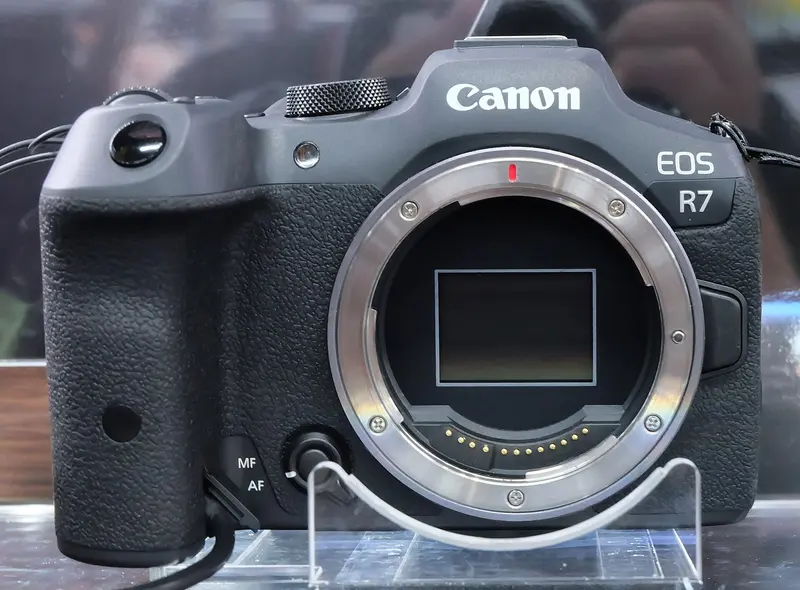
The sensor is the chip that records the image. Its size affects the look of your pictures, how they cope with low light, and the size of the lenses you'll carry.
The common sizes, with real dimensions
The names are confusing — a "1-inch type" sensor isn't an inch across. Here are the dimensions makers state for cameras in our database. The crop factor is the full-frame diagonal divided by each sensor's diagonal (our calculation).
| Format | Stated size | Crop factor | Example |
|---|---|---|---|
| Medium format | 43.8 x 32.9 mm | about 0.79 | Fujifilm GFX100S II |
| Full frame | 35.9 x 23.9 mm | 1.0 | Canon EOS R6 Mark III |
| APS-C (Fujifilm, Nikon DX) | 23.5 x 15.7 mm | about 1.5 | Fujifilm X-T5 |
| APS-C (Sony) | 23.3 x 15.5 mm | about 1.5 | Sony Alpha 6700 |
| APS-C (Canon) | 22.3 x 14.9 mm | about 1.6 | Canon EOS R50 |
| Micro Four Thirds | 17.3 x 13.0 mm | about 2.0 | OM System OM-1 Mark II |
| 1-inch type | 13.2 x 8.8 mm | about 2.7 | Sony ZV-1 II |
Canon itself describes its APS-C bodies as giving a field of view "equivalent to 1.6x the focal length of the lens".
What the crop factor means for lenses
Multiply a lens's focal length by the crop factor to get the full-frame equivalent field of view. A 50 mm lens on a Canon APS-C body frames like an 80 mm lens on full frame (50 × 1.6). That's handy for wildlife — and less handy when you want wide shots for vlogging or landscapes.
Compacts and action cameras usually quote the equivalent directly, e.g. "24–100 mm equivalent" on the Canon PowerShot G7 X Mark III.
What a bigger sensor gives you
- More light overall. At the same exposure a bigger sensor gathers more light in total, which usually means cleaner images in dim conditions.
- Easier background blur at the same framing and aperture.
- More detail potential — though resolution also depends on megapixels. The full-frame Sony ZV-E1 is 12.1MP, while the APS-C Fujifilm X-T5 is 40.2MP.
What a smaller sensor gives you
- Smaller, lighter lenses, especially telephotos. That's one reason Micro Four Thirds suits wildlife and hiking kits.
- Smaller bodies, from pocket compacts to action cameras with 1/1.3-inch or 1/1.1-inch sensors.
- More depth of field, which can help keep a whole scene sharp.
So which should you choose?
- Full frame: low light, shallow depth of field, professional work — at the cost of size and lens prices.
- APS-C: a good all-round balance for most people, including most entry-level bodies.
- Micro Four Thirds: small telephoto kits and video-focused bodies such as the Panasonic LUMIX GH7.
- 1-inch and smaller: pocketability first.
Filter by sensor on the camera list.
Last updated 3 October 2026. Some links on this page go to Amazon or other shops; we may earn a commission. As an Amazon Associate I earn from qualifying purchases.