Basics
DSLR vs mirrorless: which should you buy in 2026?
How DSLRs and mirrorless cameras differ — viewfinders, size, video and lenses — and who should still consider a DSLR.
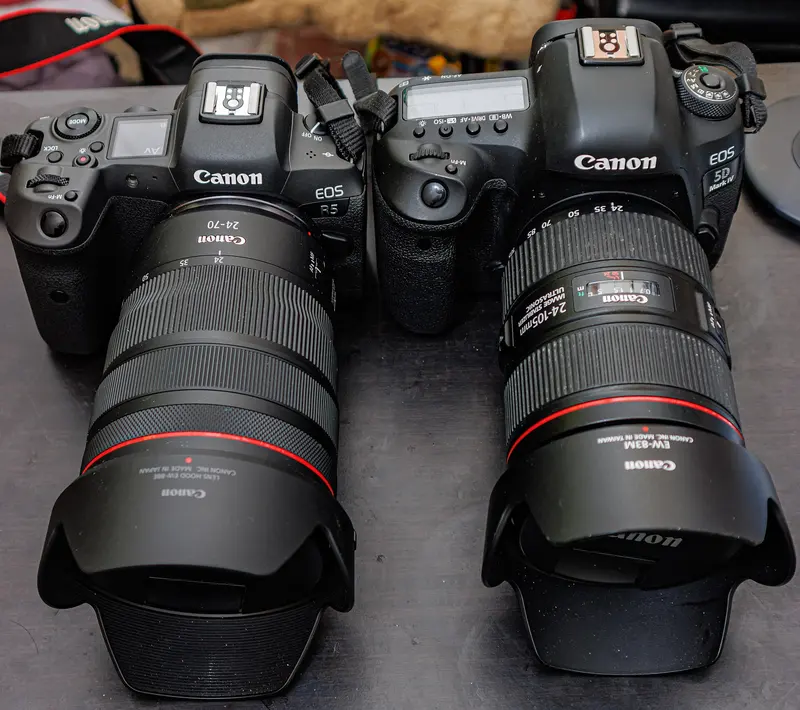
DSLRs and mirrorless cameras both take interchangeable lenses and can use large sensors. The difference is what happens between the lens and your eye.
The one-line difference
- A DSLR (digital single-lens reflex) has a mirror behind the lens that bounces the image up into an optical viewfinder. You see the real scene through glass. The mirror flips up when you take the picture.
- A mirrorless camera has no mirror. The sensor feeds an electronic viewfinder (a tiny high-resolution screen) and/or the rear screen, so what you see is a live preview of the photo, exposure and all.
You can see it in the spec sheets: Nikon lists an "eye-level pentaprism single-lens reflex viewfinder" for the D780, while mirrorless bodies such as the Nikon Z6III list an OLED electronic viewfinder with a dot count.
Viewfinder: optical or electronic?
An optical viewfinder shows the scene with no delay and uses no battery while you look through it. An electronic viewfinder shows you the image as the sensor sees it — brightness, colour and focus peaking included — which many people find easier, especially for video and in low light.
Electronic viewfinders vary a lot. The resolution is quoted in "dots": entry models in our database have around 2.36 million, while the Sony Alpha 1 II and Canon EOS R1 are listed at about 9.4 million. Some vlogging-first mirrorless cameras, such as the Nikon Z30 and Fujifilm X-M5, skip the viewfinder entirely.
Size and weight
Removing the mirror box lets makers build smaller bodies, but it isn't automatic — big sensors still need big lenses. Compare like with like, and check what each weight figure includes:
| Camera | Type | Weight (maker's figure) |
|---|---|---|
| Nikon D850 | Full-frame DSLR | 1,005 g with battery and card |
| Nikon Z8 | Full-frame mirrorless | 910 g with battery and card |
| Canon EOS 250D | APS-C DSLR | 449 g body only |
| Canon EOS R50 | APS-C mirrorless | 375 g with card and battery |
Video
Mirrorless cameras are where makers now put their video features. No DSLR in our database records video above 4K 30p, while mirrorless models go up to 6K, 7K or 8K — for example the Canon EOS R5 Mark II (8K RAW up to 60p) and the Nikon Z6III (6K RAW up to 60p). If video or vlogging matters, mirrorless is the clear direction.
Lenses and adapters
Each system has its own lens mount. Canon's DSLRs use EF/EF-S lenses and its mirrorless cameras use RF/RF-S; Canon's specifications for the EOS R8 note that EF and EF-S lenses can be attached with the Mount Adapter EF-EOS R. Nikon's Z-mount specifications say F-mount NIKKOR lenses can be used with a mount adapter ("restrictions may apply"). So a bag of DSLR lenses doesn't lock you out of mirrorless. See our lenses and mounts guide.
Who should still buy a DSLR?
- You love an optical viewfinder and mainly shoot stills.
- You already own EF or F-mount lenses and want a body that uses them directly.
- You've found a DSLR you like that suits your budget.
Canon and Nikon still list DSLRs on their UK websites (checked October 2026) — browse them on our DSLR page.
Who should go mirrorless?
Almost everyone buying new — especially if you want good video, a screen that faces you for vlogging, subject-detection autofocus, or the newest lenses. Start with our mirrorless list or try the camera selector.
Last updated 3 October 2026. Some links on this page go to Amazon or other shops; we may earn a commission. As an Amazon Associate I earn from qualifying purchases.
More guides
- Vlogging How to choose a vlogging camera
- Basics Sensor sizes explained: full frame, APS-C, Micro Four Thirds and more
- Basics Lenses and mounts: the basics before you buy into a system
- Buying advice The camera specs that actually matter (and the ones that don't)
- Checklist Buying your first proper camera: a checklist