Buying advice
The camera specs that actually matter (and the ones that don't)
A plain-English tour of a spec sheet: sensor size, megapixels, video modes, stabilisation, viewfinder, screen, inputs and weight — and how to read the small print.
Spec sheets run to dozens of lines. Here's what to look at first, using the fields on every camera page in our database.
1. Sensor size before megapixels
Sensor size shapes low-light performance, background blur and lens size (see sensor sizes explained). Megapixels matter if you crop heavily or print big; for social media and 4K video, cameras from the 12.1MP Sony ZV-E1 to the 102MP Fujifilm GFX100S II are all more than enough.
2. Video: resolution, frame rate — and crop
- Resolution: 4K is the useful standard; 6K and 8K give room to crop and reframe but create very large files.
- Frame rate: 24/25p looks cinematic, 50/60p is smoother, and 100/120p can be slowed down for slow motion.
- Crop: some modes use only part of the sensor. Makers sometimes say so (Canon lists "4K 60p (cropped)" on some models); a crop narrows your lens's view.
We show the headline modes on each camera page — for example "6.2K 30p; 4K 60p" for the Fujifilm X-S20.
3. Stabilisation — read the wording
- In-body (sensor-shift) works with every lens.
- Lens-based depends on buying stabilised lenses.
- Electronic stabilisation crops the video frame.
Makers quote "stops" of stabilisation measured to the CIPA standard, often with a specific lens. Treat the figure as a comparison between cameras, not a promise.
4. Viewfinder and screen
- Viewfinder: optical on DSLRs; electronic on most mirrorless, with resolution in dots (2.36 million is common at entry level; 5.76 million and 9.44 million on pricier bodies). Some vlogging cameras have none.
- Screen: vari-angle or flip-up screens can face you; tilting screens usually can't. Our camera pages show "Screen can face you" where the maker's information confirms it.
5. Inputs: microphone and headphones
A 3.5 mm microphone input is essential for vlogging. Some cameras also have a headphone socket (for example the Fujifilm X-S20 and X-M5). Watch for unusual sockets — the Fujifilm X100VI uses 2.5 mm.
6. Weight — and what's included
Makers measure weight differently: "body only", "with battery and memory card", or with a kit lens. Our pages always say which. Compare like with like before deciding a camera is lighter.
7. Memory cards
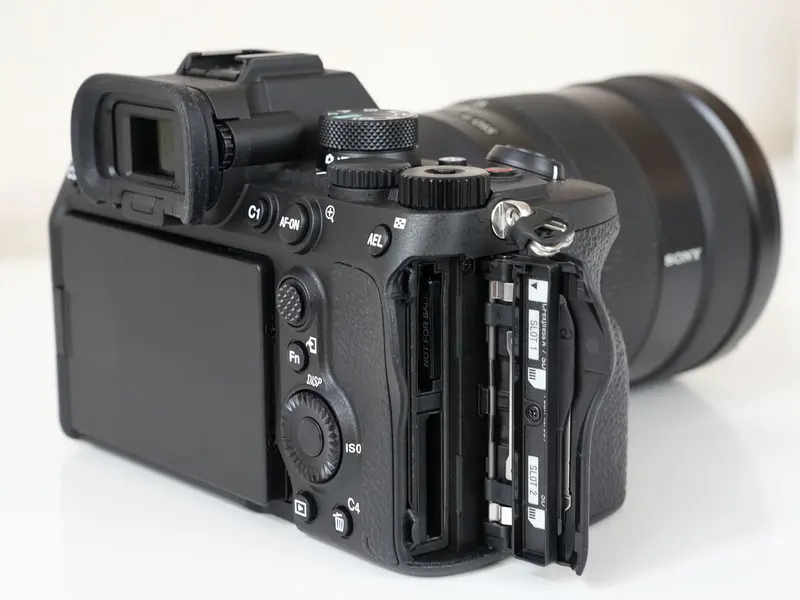
Faster video modes often need faster cards. Cameras such as the Canon EOS R6 Mark III take CFexpress Type B as well as SD. Budget for cards — see the memory card notes in our accessories guide.
What the spec sheet won't tell you
- How it feels in your hand and whether the menus make sense to you.
- How many lenses you'll realistically buy for that mount.
- Whether you'll carry it. Go and hold a few if you can.
Compare any two or three cameras on the compare page.
Last updated 3 October 2026. Some links on this page go to Amazon or other shops; we may earn a commission. As an Amazon Associate I earn from qualifying purchases.